I'm Amanda Allen Nurse, a Concord, MA real estate agent with Gibson Sotheby's, guiding move-up families and home sellers across MetroWest from first search to closing. Serving Concord, Carlisle, Lexington, Newton, Wellesley, Weston, Somerville, Belmont, Cambridge, Bedford, Lincoln, Arlington and Sudbury, MA.
Key Takeaways
•The state of the market in June 2026: The Massachusetts real estate market is split in two. Boston proper is calmer, while many suburban ring towns are showing a persistent shortage of homes for sale, with the fastest-moving properties going under agreement in about a week.
•The supply problem is long-term: Statewide inventory sits at just 16,978 listings, with inventory change of 4.3% year-over-year, and new housing permits have changed 44% between July 2021 and July 2025 — both pointing to a constrained supply pipeline.
•The price-floor argument is separate from the urgency argument: Tight supply supports long-term price floors. It does not by itself prove suburbs will accelerate faster than Boston this year.
•The bottom line: If you need to be in a specific suburban town for school, commute, or family reasons, plan around tight supply. If you have flexibility, Boston proper and Worcester are real alternatives worth comparing on price, not just narrative.
Most people picture the Boston housing market and think of the skyline.
The Seaport towers.
The Back Bay brownstones.
The bidding wars on Beacon Hill.
In June 2026, though, that's not where the real pressure is building.
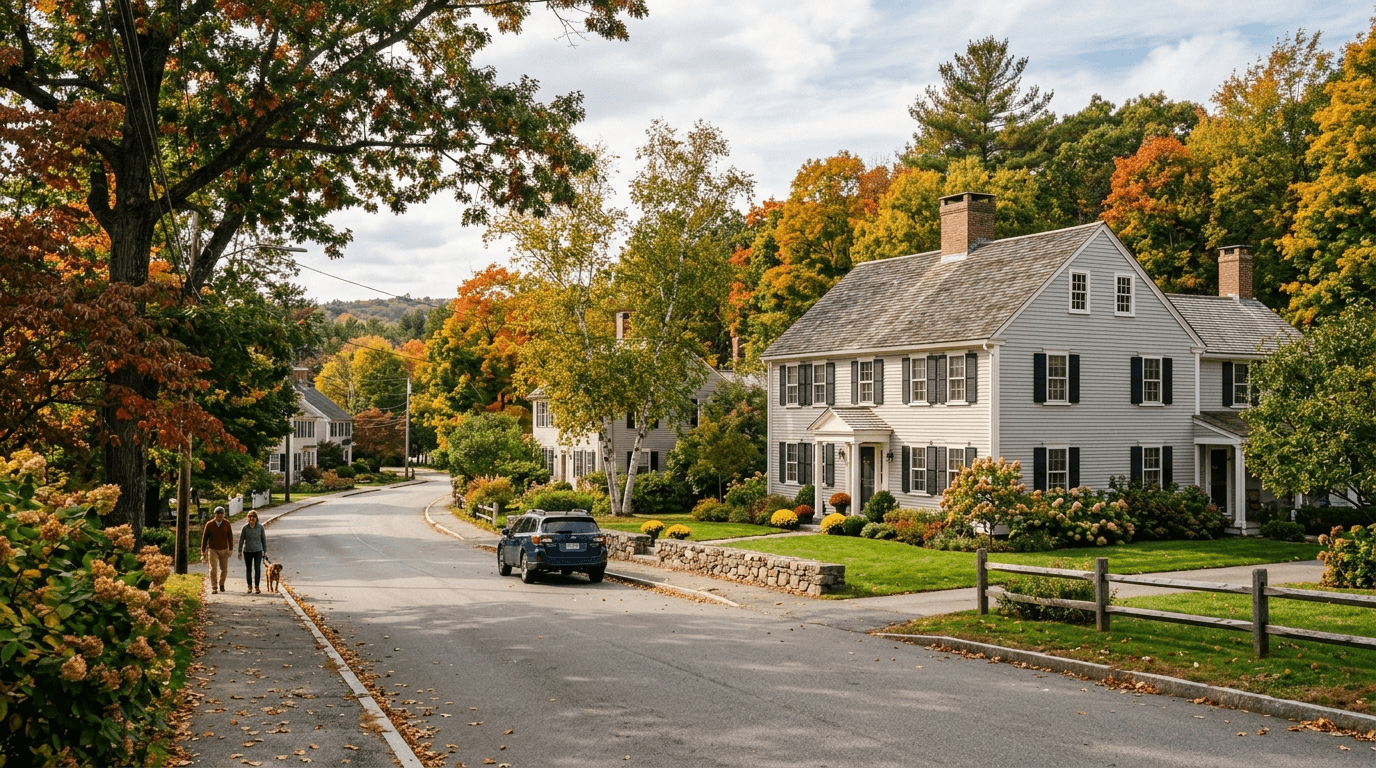
The action in the Massachusetts housing market right now is concentrated in the ring towns outside Route 128 — places like Acton, Bedford, Winchester, and Concord. These communities aren't just "doing well." On the velocity measures we can verify, they're moving faster than Boston proper.
Here's the core issue:
Statewide forecasts for 2026 put Massachusetts appreciation at 3% to 5%, Boston at 2.5% to 4%, and Worcester at 2.4%. That's a real spread — but a narrow one. We're talking roughly 0.5 to 1 percentage point per year between the state and Boston.
The suburbs aren't blowing past Boston in a single year. The case for suburban strength is mostly about tight supply and fast sales, not runaway appreciation.
So if you're asking what the market actually looks like right now, the honest answer is this: Boston is calmer. The suburbs are tighter on supply and faster on sales. The annual price gap is real but modest.
Here's what the numbers actually support — and what that means if you're buying or selling in Massachusetts this year.
How Do Suburbs Compare to Boston Proper?
The forecasts tell a clear, if moderate, story.
Massachusetts as a whole is projected to appreciate 3% to 5% in 2026 — at or above Boston's projection of 2.5% to 4% and Worcester's 2.4%. For context, national appreciation forecasts range from about 1.2% to 4%, which puts Massachusetts near the top of that range.
Local Price Appreciation Forecasts
Places Massachusetts, Boston, Worcester, and the cited national range in one percent-based comparison of expected home-price appreciation.
Places Massachusetts, Boston, Worcester, and the cited national range in one percent-based comparison of expected home-price appreciation.
What's driving the statewide number? Not Boston condos. The strength is coming from ring towns, where families are moving outward for schools, yards, space, and commuter rail access.
But here's what this data doesn't say: a 0.5 to 1 percentage point annual spread between the state and Boston doesn't produce a dramatic price gap in a single year. If that spread held steady, it would take many years of compounding to materially widen things further.
That's an implication most coverage skips entirely: on these forecasts, Boston proper is the relative bargain. If you're flexible on housing type and lifestyle, a Boston condo or two-family is worth comparing on price-per-square-foot before you stretch into a $900K ring-town colonial.
Why Is Suburban Supply So Tight?
The ring towns aren't in a bubble. They have a long-term shortage — a basic mismatch between how many families want in and how many homes are actually listed or being built.
Think of it like a popular restaurant on a Friday night. The wait is long because there aren't enough tables. Most nights you eventually get seated. But if you have a 7 p.m. reservation you can't move, you don't skip the line — you show up and wait.
That's the practical situation for any buyer who needs a specific town for school start dates or a job.
Statewide, there are only 16,978 homes currently listed for sale, with inventory change of 4.3% year-over-year. The construction pipeline that would normally help has shifted sharply — new housing permits have changed 44% between July 2021 and July 2025.
Massachusetts 2026 Housing Market Snapshot
A mixed-unit hero snapshot of Massachusetts’ 2026 housing outlook, combining price growth, inventory, permitting, and mortgage-rate expectations.
Price outlook
Projected statewide appreciation3% to 5%
Supply
Homes currently listed16,978
Inventory change year-over-year4.3%
Construction pipeline
New housing permits change (July 2021 to July 2025)down 44 percent
In plain terms: the homes that would have eased pressure in towns like Acton, Bedford, Winchester, and Concord didn't get built at the pace the prior decade saw. That shortage doesn't fix itself this year.
One thing worth separating out clearly: tight supply supports long-term price floors. It doesn't by itself prove near-term price acceleration. Those are two different arguments, and blending them leads to bad decisions.
What Numbers Show the Suburbs Are Moving Faster Than Boston?
The clearest evidence isn't appreciation. It's speed.
The table below summarizes spring 2026 velocity and price signals for several Boston-area suburbs, based on aggregated town-level MLS market reports and local brokerage commentary.
Boston-Area Suburban Market Velocity and Price Signals
Compares recent price signals and days on market for selected Boston-area suburbs, Worcester, and Boston single-family homes in spring 2026.
Category
Recent Price Signal
Days on Market
Acton
Sale prices up over 20% YoY
~7 days
Bedford
Median price +20.3% YoY (March 2026)
Under 2 weeks
Winchester
Median +35.2% in one year
Under 2 weeks
Concord, MA
Median list near $2.13M; only 56 active listings
Days, not weeks
Worcester
Median around $450K
24 days
Boston (single-family)
Median around $857,000
20–32 days
Source: aggregated town-level MLS market reports and local brokerage market commentary, spring 2026.
A few things stand out immediately.
Acton is one of the fastest-moving markets in the table — even though it's far from an entry-level town. That flips the usual affordability logic. You'd expect the most expensive suburbs to slow first. Instead, many of them are moving faster than Boston proper.
As one local market summary put it: "56 active listings isn't normal — it's a bottleneck."
You can feel that pressure in real time on Reddit and local Facebook groups. Buyers describe scrambling for pre-approvals at 11 p.m. and touring homes the morning they hit the market. That's not a healthy environment for buyers. But it's the market that exists in those specific towns right now.
Will Mortgage Rates Break Suburban Prices?
This deserves a direct answer.
At today's rates, the monthly payment on a $750K home is meaningfully higher than it was a few years ago. That payment shock is real, and it absolutely prices some buyers out. Higher rates and higher insurance costs hit both sides of the market — they keep sellers anchored to their sub-3% mortgages, and they squeeze what buyers can afford.
So why does the suburban segment stay tight despite the payment math?
Mortgage-rate expectations cluster around 6% to 6.4%, with 6% specifically cited as the level that could bring more buyers and sellers back into the market.
Mortgage Rate Markers to Watch
Shows the narrow rate band discussed across 2026 outlooks, including the 6 percent level cited as a potential trigger for more buyer and seller activity.
1. Some buyers are genuinely sidelined by the payment. They're not in the data because they're not transacting.
2. The buyers who are active in the $900K-plus ring towns tend to be move-up buyers and dual-income households who are less rate-sensitive than first-timers. They're trading equity, not stretching to a maximum payment.
That's why suburban velocity has held up even as rates haven't dropped. It's also why a rate move toward 6% could pull demand back into the market faster than it pulls new supply in these towns — which is the opposite of the cooling some buyers are hoping for.
On the sales side, the forecasts are spread wide. The National Association of Realtors is forecasting a 14% surge in existing home sales in 2026. Zillow forecasts 4.3%. Redfin forecasts 3%. These are national figures used here as a directional proxy for Massachusetts activity.
Existing Home Sales Forecasts for 2026
Compares three national forecasts for existing-home-sales growth referenced in the source article.
Compares three national forecasts for existing-home-sales growth referenced in the source article.
The honest read: this is not a consensus. A 3% to 14% range is a wide disagreement. The safer interpretation is that more activity is likely, but the magnitude is genuinely uncertain.
For buyers, the practical takeaway is this: more listings don't automatically mean better deals if more buyers show up at the same time. Plan for either scenario rather than betting on one.
Is Worcester Replacing the Boston Suburbs as the Hotspot?
This is a fair pushback — the idea that heat has rotated away from Boston suburbs toward secondary cities like Worcester, making the suburban thesis mistimed.
Here's what the numbers actually show.
Worcester is genuinely hot. National hotness rankings have flagged it repeatedly. But Worcester's 2.4% appreciation forecast for 2026 still sits below the Massachusetts statewide forecast of 3% to 5%.
Local Price Appreciation Forecasts
Places Massachusetts, Boston, Worcester, and the cited national range in one percent-based comparison of expected home-price appreciation.
Places Massachusetts, Boston, Worcester, and the cited national range in one percent-based comparison of expected home-price appreciation.
On forecast appreciation, Boston-area suburbs are projected to run slightly ahead of Worcester. On velocity, both markets are fast. They're not in rotation — they're running in parallel, driven by the same underlying pressure: buyers priced out of one tier shopping the next tier down.
That points to a recommendation worth stating clearly: for many buyers, Worcester is the more accessible market, and it deserves serious consideration. A typical Worcester home is dramatically cheaper than a typical MetroWest home. If your job, family, and lifestyle work from Worcester County, you get similar urgency with much lower payment exposure.
The case for stretching into a $550K to $900K MetroWest home over Worcester is specific, not general. It applies when a particular school district, commute, or family network matters enough to pay for it. If those factors aren't decisive for you, the lower-priced market is the more rational choice on the numbers.
What About Insurance, Recession Fears, and Rising Costs?
These concerns are valid, and the costs cut both ways.
The average U.S. homeowner now pays $2,966 a year for insurance, up $164 from 2025, according to The Zebra's 2026 State of Insurance report. For coastal Massachusetts buyers — including the Cape, North Shore, and South Shore — private flood insurance is increasingly being treated as a core housing cost, not an optional add-on.
Here's the symmetric read on what that means for the market:
Rising ownership costs lock some existing owners in place. Owners with a sub-3% mortgage and a manageable insurance bill are anchored where they are. That tightens supply. Those same costs also reduce buyer purchasing power and willingness to transact. That softens demand.
Net effect in the Boston ring towns so far: supply has tightened faster than demand has softened, which is why velocity remains high. That balance isn't guaranteed to hold. If insurance and rate costs keep rising, both sides cool — and the market gets slower, but not necessarily cheaper.
For your own decision, the implication is straightforward: total cost of ownership matters as much as the purchase price. Buying now locks you into today's rate and today's insurance baseline. Waiting may or may not improve the purchase price, but it doesn't automatically lower your ongoing costs.
What Does This Mean for Your Family?
The Massachusetts suburban market isn't one single market. It has tiers, and each behaves a little differently.
Are Inner-Ring Towns Still the Luxury Pressure Cooker?
Yes — and that's worth being honest about.
The inner ring includes towns like Newton, Winchester, and Concord: high-demand communities where schools, commute access, walkability, and reputation support very high prices.
Newton's 2025 median sits at $1.8 million.
Median Home Prices in Selected Family-Oriented Towns
Compares 2025 median home prices for selected Massachusetts towns where numeric prices were provided.
Compares 2025 median home prices for selected Massachusetts towns where numeric prices were provided.
For most buyers, that price tag means the window in these specific towns has effectively already closed. The honest message isn't "buy now before it's too late." It's: be realistic about whether you're actually the buyer for these towns, or whether you're shopping the next tier out.
For sellers in these towns, this is still a strong position — but pricing too far above comparable sales can still cost you momentum in the first week.
Are MetroWest and the 495 Belt the Fastest-Moving Zones?
Yes. This is the velocity zone — towns like Acton, Bedford, Sudbury, and their neighbors.
Boston-Area Suburban Market Velocity and Price Signals
Compares recent price signals and days on market for selected Boston-area suburbs, Worcester, and Boston single-family homes in spring 2026.
Category
Recent Price Signal
Days on Market
Acton
Sale prices up over 20% YoY
~7 days
Bedford
Median price +20.3% YoY (March 2026)
Under 2 weeks
Winchester
Median +35.2% in one year
Under 2 weeks
Concord, MA
Median list near $2.13M; only 56 active listings
Days, not weeks
Worcester
Median around $450K
24 days
Boston (single-family)
Median around $857,000
20–32 days
For buyers, that means you can't treat listings casually. If the right home appears, you need to be ready the same day.
For sellers, your first week on market is everything. That's when the most serious buyers are watching most closely.
Is Worcester County a Real Alternative?
For many buyers, yes — and this deserves a clearer call-out than it usually gets.
Worcester County is absorbing spillover from buyers priced out of Eastern Massachusetts and MetroWest. Its 2026 appreciation forecast of 2.4% sits below the statewide 3% to 5%, but it's positive, and the entry price point is meaningfully lower than the MetroWest band.
Local Price Appreciation Forecasts
Places Massachusetts, Boston, Worcester, and the cited national range in one percent-based comparison of expected home-price appreciation.
Places Massachusetts, Boston, Worcester, and the cited national range in one percent-based comparison of expected home-price appreciation.
If your work, family, and lifestyle can accommodate a Worcester County address, the numbers often look better on paper. You give up some appreciation upside and some commute convenience. You gain a smaller mortgage, a smaller insurance bill, and far less competition at the bid.
Is Boston Proper Softer Than the Suburbs?
Yes — and that matters more than most coverage admits.
The Boston condo market is meaningfully softer than the suburban family-home market on the velocity measures we can verify. The 2026 appreciation forecast for Boston is 2.5% to 4%, only slightly below the statewide 3% to 5%.
Local Price Appreciation Forecasts
Places Massachusetts, Boston, Worcester, and the cited national range in one percent-based comparison of expected home-price appreciation.
Places Massachusetts, Boston, Worcester, and the cited national range in one percent-based comparison of expected home-price appreciation.
For certain buyer profiles, that makes Boston proper the more rational choice:
•Single buyers and couples without school-age children
•Buyers who value walkability and transit over yard size
•Investors focused on price-per-square-foot rather than school district
•Anyone whose budget tops out below the MetroWest entry point
The narrative that everyone should chase the suburbs isn't supported by the data. What the data actually supports is a more careful read: buy where the math and your life genuinely align — and for many buyers, that's Boston or Worcester, not a $900K ring-town colonial.
Should You Buy Now or Wait?
If you're a long-term, quality-of-life buyer with a specific suburban town in mind, here's the honest answer: plan around tight supply in your target town, but don't let urgency talk you out of basic discipline.
If you're flexible on location, the answer is different: compare Boston, Worcester County, and a MetroWest target side by side on monthly cost, not just narrative. The relative-value picture isn't what the headlines suggest.
If you're waiting for the suburbs to suddenly cool, the current supply numbers don't support that plan. New construction is limited. Buyer demand is still concentrated in the same towns. Inventory is tight.
If you're waiting because the payment math doesn't work, that's a legitimate reason to wait or shift markets. It's not weakness. It's arithmetic.
Here's how to compete in a tight market without losing your head:
•Get pre-underwritten, not just pre-approved. Pre-approval is a lender's initial estimate based on a basic review. Pre-underwriting means a lender has reviewed your pay stubs, tax returns, and bank statements upfront and issued a stronger conditional commitment. Sellers notice the difference.
•Tour on the day a home lists. In a 7-day market, waiting for the weekend open house often means waiting too long.
•Price insurance into your budget from day one. Use the $2,966 national average from The Zebra as a baseline, and add more for coastal exposure.
•Compare assessed value to market value. Assessed value is what your town uses to calculate your property tax bill. Market value is what buyers are actually paying right now. In hot ring towns, the gap between them can reveal how much room sellers may have to push on price.
•Know your walk-away number before offers are due. Fast markets punish hesitation — but they also punish emotion.
What Is the Bottom Line for June 2026?
The Massachusetts housing market is split.
Boston proper is calmer. The suburban ring towns are tight on supply and fast on sales. The annual appreciation spread between them is real but modest.
The supply situation isn't a one-season spike. It's a longer-term shortage. The homes that would have relieved pressure in 2026 didn't get built at the prior pace. Many existing owners are reluctant to sell. Buyers continue to compete for the same high-quality towns.
That argues for long-term price stability in those towns. It doesn't argue for panic. And it doesn't mean ring-town suburbs are the right answer for every buyer.
If you're flexible, look hard at Boston proper and Worcester County before you stretch. If you're not flexible, build your plan before the right house appears.
If you want to see the specific numbers for your town or neighborhood, drop a reply with the area you're watching. I can help you understand what's selling, how fast it's moving, and what a smart offer strategy looks like right now.
Common Questions
What is the state of the Massachusetts real estate market in June 2026?
The Massachusetts real estate market is split in two in June 2026. Boston proper is calmer, while suburban ring towns face a supply crisis with homes selling quickly. Statewide inventory is only 16,978 listings, down 4.3% year over year, and suburban demand is still pushing prices higher.
Why is the suburban housing market around Boston hotter than Boston proper?
The suburban housing market is hotter because demand for schools, yards, and commuter rail is hitting fixed supply. The article says suburban prices are up roughly 60% since 2020, compared with about 15% in Boston proper. New permits are down 44% versus 2021, so relief is not arriving quickly.
How fast are homes selling in Boston-area ring towns right now?
Homes in Boston-area ring towns are selling very fast, with some markets moving in about one week. Acton real estate is described as one of the fastest examples, while Worcester is around 24 days. That speed shows buyers have little time to wait, compare, or negotiate.
Will waiting make it easier to buy in Massachusetts suburbs this year?
Waiting is unlikely to make suburban Massachusetts real estate easier in 2026, based on the article’s supply math. Inventory is down 4.3% year over year, and homes that could ease prices were not built. In towns like Acton or Concord, the shortage persists rather than resets.
Is the Boston housing market weaker than the suburbs right now?
The Boston housing market is calmer than the suburbs right now, especially compared with fast-moving ring towns. The article notes Boston proper has gained about 15% since 2020, while suburbs are up roughly 60%. Boston condos are also described as meaningfully softer, showing demand has shifted outward.